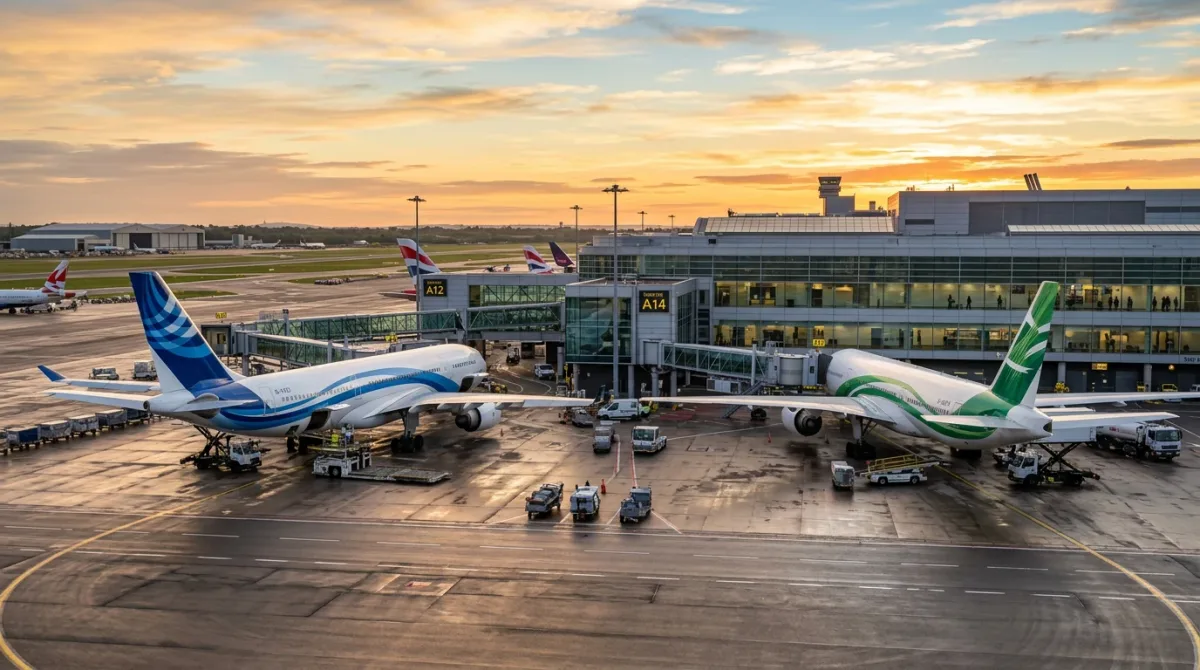
A codeshare is an agreement in which one airline markets and sells tickets for a flight that a different airline actually operates, using its own flight number and code on that seat. The flight itself is flown by a single "operating carrier," while one or more "marketing carriers" sell it under their own designator, per the U.S. Department of Transportation's disclosure rule at 14 CFR Part 257. That is why the same physical flight can show up on an airport board, or in a booking search, under two or three different flight numbers at once.
The mechanics are simple once the terms are separated. The operating carrier supplies the aircraft, crew, gate, and ground handling. Each marketing carrier attaches its own two-letter airline code and flight number to a block of seats it has agreed to sell, and that carrier's frequent-flyer program, fare rules, and check-in process apply to the passengers who booked through it, according to a codeshare explainer from The Points Guy. A traveler who books a "Delta" flight number, for example, may actually be flying on a Virgin Atlantic, Aeromexico, or Korean Air aircraft with Delta cabin crew nowhere aboard.
Why do airlines codeshare instead of flying the route themselves?
Codesharing lets a carrier sell tickets to a destination it does not serve with its own aircraft, without the cost of adding a new route, buying slots, or stationing crews abroad. For the marketing carrier it is a low-capital way to extend a route map; for the operating carrier it fills seats it might otherwise sell only through its own, smaller sales channel. The arrangement is central to how the three global alliances, oneworld, SkyTeam, and Star Alliance, connect member airlines' networks into something that reads to a passenger as a single system, even though each flight has only one operator.
What must an airline disclose about a codeshare flight?
Under 14 CFR Part 257, a U.S. or foreign carrier and any ticket agent selling a codeshare flight must disclose the identity of the airline that actually operates it, whenever the code shown does not match the operator. The disclosure has to name "the corporate name of the transporting carrier and any other name under which the service is held out to the public."
The rule sets out where that disclosure has to appear. On flight-schedule displays, whether on a desktop site or a mobile app, the operating carrier's name must sit immediately next to the code-share flight, in a font no smaller than the rest of the itinerary; pop-ups or buried disclosures do not satisfy the rule. A reservation agent has to tell a passenger by phone, the first time a code-share flight is offered, that a different airline will operate it. Before a purchase is completed, the written confirmation must state "Operated by [carrier name]." The same disclosure obligation extends to print, radio, and television advertising. The Department of Transportation's Office of Aviation Consumer Protection lists more than three dozen enforcement orders issued against airlines and travel agencies for violating the disclosure requirement, evidence that the rule is actively policed rather than a formality.
What changes for a passenger on a codeshare seat?
Frequent-flyer mileage and elite-status benefits generally follow whichever carrier's program the ticket was booked under, and codeshare partners typically honor each other's baggage allowances and through check-in for a single itinerary, letting a passenger book a multi-airline trip on one ticket through one carrier's website, according to The Points Guy. What does not carry over automatically is the onboard product. Seat width, meal service, and premium-cabin amenities are set by whichever airline operates the aircraft, so a seat marketed as premium economy under one carrier's code can turn out to be a standard economy seat if the operating carrier does not offer that cabin at all. Reading the "operated by" line on a booking confirmation is the reliable way to know which airline's aircraft, crew, and seat map actually apply.
Who is responsible if a codeshare flight is delayed or bags go missing?
Passenger-protection rules generally treat the operating carrier as the one accountable for what happens on the aircraft itself, since it controls the crew, the schedule, and the ground handling. Baggage liability on an international codeshare trip can nonetheless become a point of confusion for travelers, which is why the Department of Transportation's Office of Aviation Consumer Protection maintains separate guidance specifically on baggage liability for international code-share itineraries alongside its disclosure rule. A passenger with a problem on a codeshare segment is generally better served contacting the operating carrier directly, since the marketing carrier that sold the ticket may have limited ability to resolve an issue that happened on someone else's aircraft; the "Operated by" line on the confirmation identifies which carrier that is.
The same logic explains why the disclosure requirement exists in the first place. Before Part 257 took effect, a passenger could book what appeared to be a flight on a major carrier and discover only at the airport that a smaller regional or foreign partner airline, with a different safety record, seat configuration, or level of English-language service, actually operated the aircraft. Requiring the operating carrier's name at search, at the first phone offer, and again in writing before payment closes that gap at each stage of a booking, rather than leaving the disclosure to a single point where it is easy to miss.
How a codeshare deal comes together
A codeshare announced in mid-2025 shows the pattern at a larger scale. IndiGo, Delta Air Lines, Air France-KLM, and Virgin Atlantic signed a memorandum of understanding combining codeshare agreements with wider commercial cooperation, letting IndiGo sell onward itineraries under its own "6E" code onto partner flights, subject to regulatory approval, according to the carriers' joint announcement on Air France-KLM's newsroom. The deal links IndiGo's domestic Indian network, more than 400 aircraft flying over 2,200 daily flights, to KLM service from Amsterdam to roughly 30 European cities, Delta and KLM flights from Amsterdam to the United States and Canada, and Virgin Atlantic flights from Manchester to the United States. KLM's Amsterdam-Hyderabad route, which launched in September 2025, was built into the same connection network. Delta separately said it intends to resume nonstop Atlanta-Delhi service, subject to government approval. None of those single-carrier routes changes; what changes is that a ticket sold under any one partner's code can now route a passenger across all four networks on connecting itineraries.
| Term | What it means |
|---|---|
| Operating carrier | The airline that supplies the aircraft, crew, and ground handling for the flight |
| Marketing carrier | A partner airline that sells seats on that flight under its own code and flight number |
| Codeshare disclosure | The federally required notice, at search, at booking, and before payment, naming which carrier actually operates the flight |
| Interline/alliance agreement | A broader deal, often paired with codesharing, covering baggage transfer, mileage recognition, and through check-in across carriers |
For a related business news perspective, read How Airline Loyalty Programs Actually Make Money for Delta, United and American.