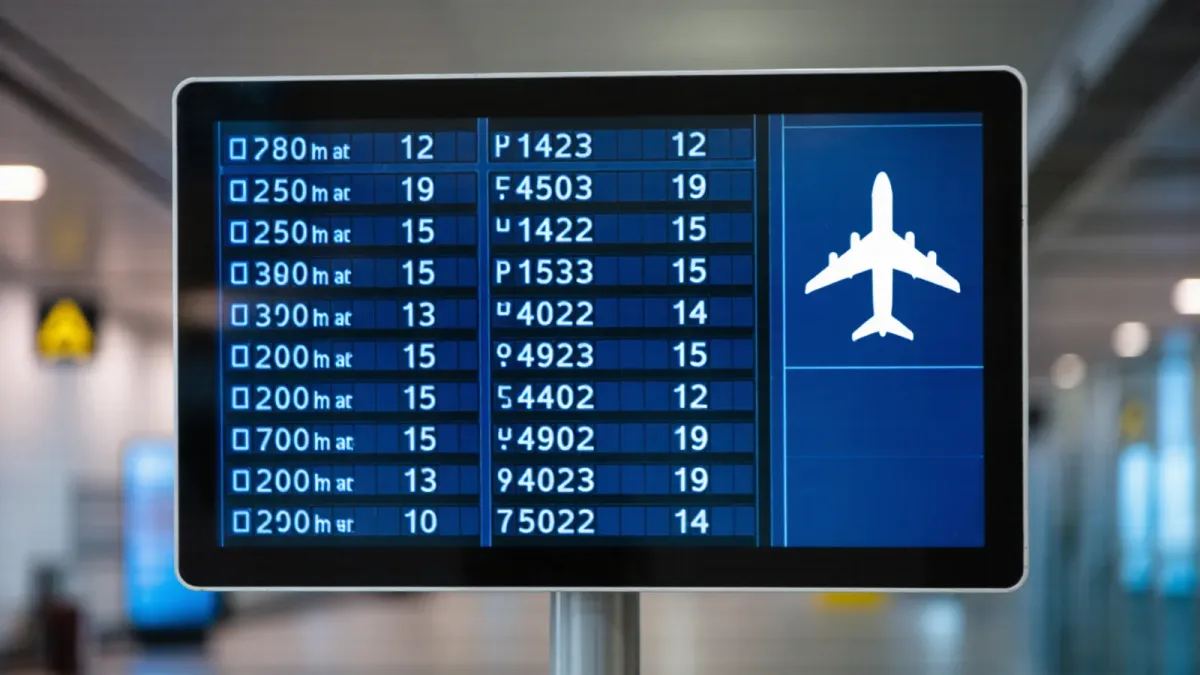
A gate assignment is a rolling plan, re-optimized many times a day, and at a large hub the morning's printed gate for an evening flight is right only until the first delay arrives. Airports and airlines reassign gates constantly because a gate is not the airline's property but a slot in a shared schedule built around aircraft rotations: the same narrowbody might touch four gates in a day, and each change ripples through the plan.
The number on a boarding pass is generated at check-in from that day's plan. Everything that happens afterward — a late inbound aircraft, a broken tug, an international arrival needing a federal-inspection-capable gate — moves gates around. Understanding the mechanics explains both why changes happen and why the airport cannot simply pin gates in advance.
What is a gate actually assigned to?
Gates are assigned to aircraft, not flights. A flight number exists all day; the airframe flying it exists in a rotation that started before dawn in another city. When that airframe arrives late, the airport either holds its gate — blocking the next flight assigned there — or moves the departure to a free gate. Assignments also respect hard constraints: an international arrival needs a gate with federal inspection facilities; a widebody physically fits only certain stands; and aircraft with different boarding-door geometries cannot share some gates at all.
Why does the change happen so late?
Because the trigger is usually the inbound aircraft's actual movement, which no one controls. An arrival blocks its gate until push-back, so a 40-minute inbound delay displaces every later aircraft touching that stand. Ramp resources compound it: a gate without an available push-back tug or ground crew is unusable, and at peak banks the constraint binds. The reassignment therefore lands 30-90 minutes before departure — late from a passenger's view, immediate from the operation's view. Airports hold buffer stands precisely to absorb this, and at the biggest hubs a stand-control team rewrites assignments in real time against predicted turn times per aircraft type.
Do airlines choose their gates?
Both models exist. Some airports lease gates to carriers, giving the airline scheduling control within its own suite; others run common-use gates assigned centrally by the airport's system, standard at terminals serving many carriers. Even a leased suite is shared during the bank when an airline's own departures exceed its gates. Leases explain geography — why one carrier's flights cluster in one concourse — but not stability, because rotation pressure operates identically in both models.
How should a traveler handle a gate change?
Three habits cover nearly every case. Trust the app and airport displays over the boarding pass; the printed gate ages from the moment it prints, and airline apps push reassignments within minutes of the stand-control decision. Budget walking time between wings of large terminals — a change from concourse A to C at a major hub can mean a 20-minute trek or a train ride, and boarding still closes at the original time, typically 15 minutes before departure for domestic flights. And don't arrive at the old gate and wait: a closed door at the reassigned gate is the most expensive outcome of a cheap notification. The gate number is the least stable fact on a boarding pass; the boarding time is the one to defend.