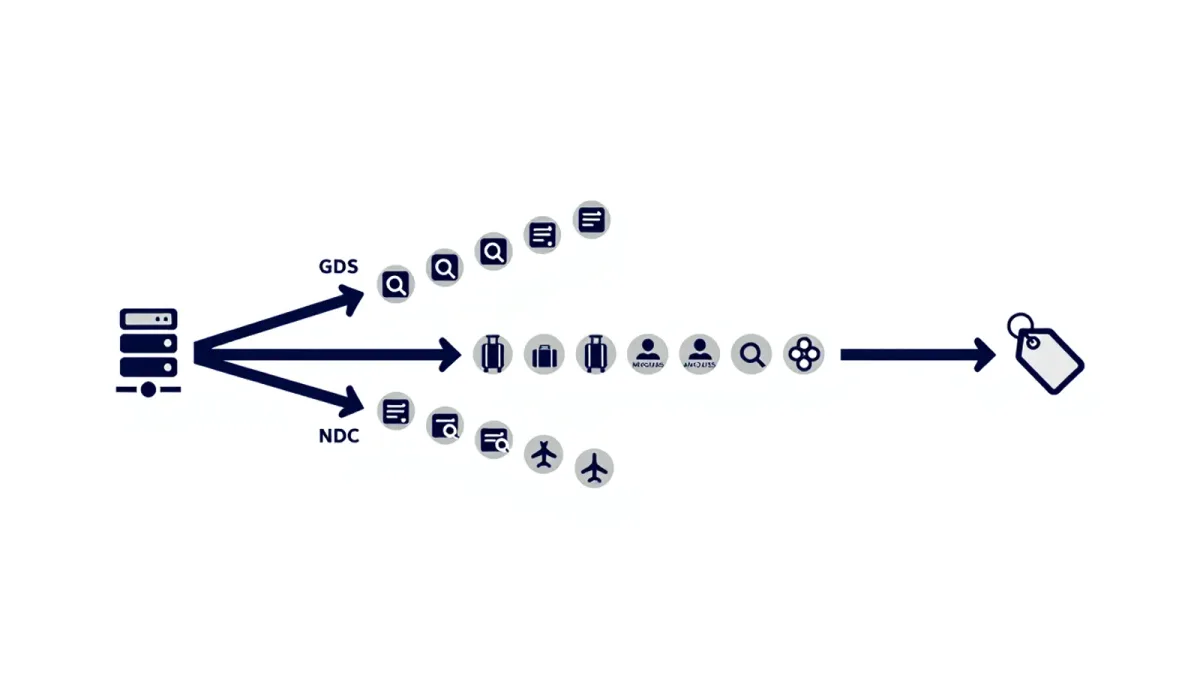
Flight search engines work by querying fare databases, not the airlines themselves: most run against one of three global distribution systems (GDS) — Amadeus, Sabre, and Travelport — which hold published fares and seat availability for hundreds of airlines, while a newer standard called NDC lets airlines push their own richer content directly to travel sellers. Which pipeline a search site uses is the single best explanation for why the same flight can show a different price, or not appear at all, depending on where you look.
This guide explains the plumbing; it is not a recommendation of any specific booking site.
What is the GDS, and why does it still matter?
The global distribution systems began as airline reservation computers in the 1960s — Sabre from American Airlines, others following — and evolved into the neutral plumbing connecting airlines, travel agencies, and online booking sites. When a search engine shows a Delta fare next to a Lufthansa fare, it is almost always reading GDS-hosted content: fare rules, availability counts by booking class, and schedules, all standardized decades ago.
Standardization is both the strength and the limitation. The GDS reliably prices complex itineraries — two airlines, three cities, one ticket — that no airline's own website handles well. But the model was built for published fares, and airlines have spent a decade trying to move differentiated offers — seat bundles, loyalty pricing, ancillaries — into channels they control.
What is NDC, and why should a traveler care?
NDC (New Distribution Capability) is the IATA-developed XML standard through which airlines sell directly to travel sellers: richer content, dynamic offers, and ancillaries presented the way the airline wants them. A fare visible on an airline's own site — say, a discounted bundle with a checked bag — may not exist in the GDS feed a comparison site reads, which is one concrete reason the airline site and the metasearch show different prices for the same seat.
Airlines have pushed NDC with volume-based incentives and, in some cases, surcharges on GDS bookings, per carriers' distribution announcements through the 2020s. The traveler effect: comparison shopping now requires checking both the metasearch results and the airline's own site, because no single channel carries every offer.
Where do metasearch and OTA prices actually diverge?
- Metasearch (Google Flights, Kayak, Skyscanner): aggregate many feeds and route you to a seller. Prices shown are cached for minutes, which explains fleeting mismatches.
- Online travel agencies (OTA): hold their own ticketing authority through a GDS and add their own fare markups or discounts on top of published fares.
- Basic-economy gaps: some ultra-low content is excluded from certain channels entirely by airline policy.
The practical protocol for 2026: search broadly on a metasearch to find the route and the price band, then price the identical itinerary on the operating airline's site before purchasing. The lowest total price — with the bag you actually need — wins, and the airline-direct ticket comes with the carrier's own support when the schedule breaks.
None of this plumbing is visible at checkout, which is precisely why the same seat can carry three prices on the same evening. The fare is real in every case; the pipeline differs.