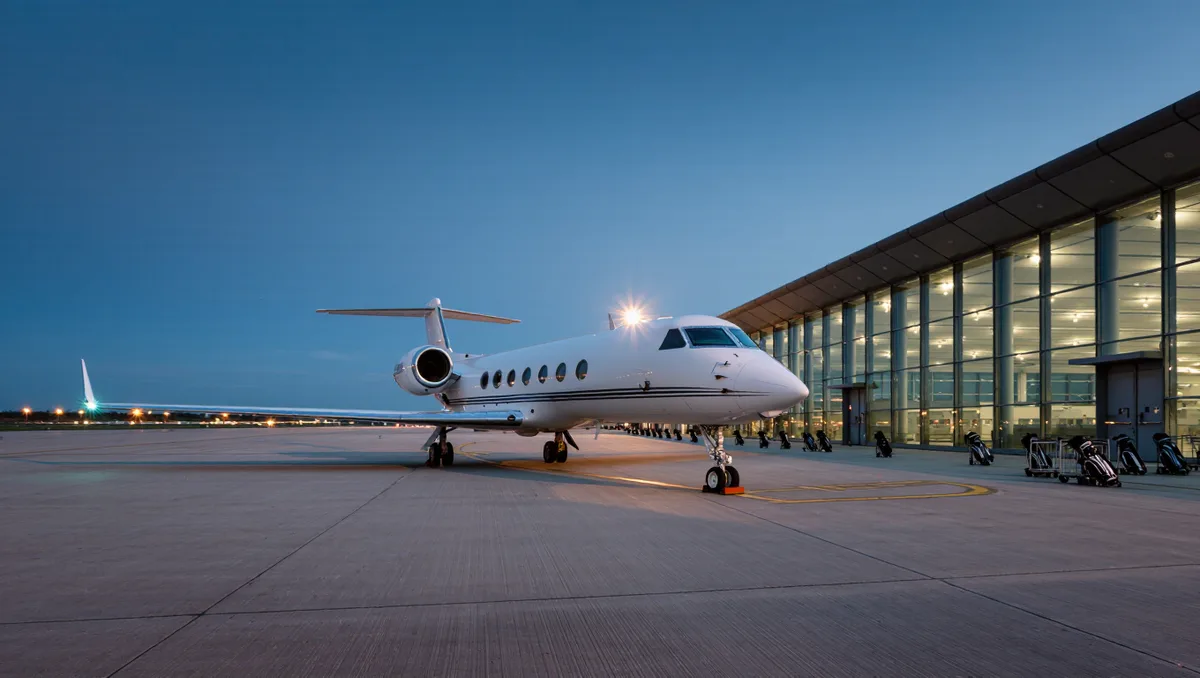
Private aviation can turn a long drive or a two-stop commercial itinerary into a short direct flight to a course like Arcadia Bluffs or Bandon Dunes. That is the claim, and the arithmetic behind it is genuine: a drive from the Chicago suburbs to Arcadia can take most of a day, while a flight from Chicago Executive Airport takes about an hour, according to Chicago Golf Report. But the case comes from a charter company's own sales chief, and it deserves a second look before anyone books.
The argument was made by Paul Kloet, Executive Vice President of Sales and Marketing at Jet Linx, on the Chicago Golf Report Podcast. He is a golfer and a Chicago-area resident, and his figures are plausible. They are also the figures of a company that sells the flights. Readers should treat this as a vendor's pitch with real substance, not an independent audit.
The time math is the strongest part of the case, and it is worth checking against the wider travel picture. Kloet recalled one drive to Arcadia Bluffs that took close to eight hours each way. "Let's say conservatively it's 14 hours," he said of the round trip. "I've given you back a full day effectively of golf—or, if you want to talk about it in golf terms, I've given you two rounds." A private flight from Chicago Executive reaches the area in roughly one hour. For a group that values recovered time, that is a real trade: money for a day of golf. For related coverage, see REAL ID Marks One Year of Enforcement: Queues Cooled, Gaps Remain.
The access argument rests on a genuine structural fact. "The unique thing about private aviation is there are a little over 5,000 airports in the country, and commercial airlines serve 500 of those," Kloet said. Smaller airports sit closer to remote courses, which cuts ground time at both ends. That matters most for places like Sand Hills in Nebraska and Prairie Dunes in Kansas, where the isolation is part of the appeal and also what makes airports near them hard to reach by scheduled service.
Where the pitch is strongest — and where it thins out
The strongest case is the group of four or more. Kloet's own framing concedes the point: a private flight "may sound extravagant when evaluated strictly as transportation." The calculation changes when the cost is shared, the drive is avoided and an extra day is recovered. A light jet to Big Cedar Lodge near Branson, which he says has drawn strong Jet Linx customer interest over the past two years, is presented as a realistic option for a group of four. That is the sweet spot. A solo traveler paying the full charter has a much weaker case. This connects to our earlier piece, ETIAS Has No Start Date Yet: What Visa-Free Travelers Know in Mid-June.
The Bandon Dunes story is the emotional core of the pitch, and it is honest about what private flying cannot do. Kloet lost about a day and a half of a Bandon trip to commercial flight problems, including a scheduled round at Old Macdonald. "I still regret that because of a flight delay," he said. Private aviation reduces connections and keeps the group together, but "it cannot eliminate weather," as the report itself notes. A traveler weighing the option should hear that plainly: the upgrade buys fewer failure points, not immunity.
Does the business case hold up?
The corporate framing is where skepticism earns its keep. Kloet offers the example of a company inviting 12 customers on a golf trip and, if each relationship could produce $1 million in long-term business, placing "$12 million in potential revenue on the aircraft." "You can attribute an ROI to that," he said. Potential revenue is not revenue, and the $1 million-per-relationship figure is an assumption, not a measured result. The shared-flight bonding argument — four or five hours together on the course, extended by hours in the cabin — is reasonable. The return-on-investment framing is marketing arithmetic.
There is also a counterweight the pitch does not address: commercial travel is not static. For a Chicago-to-Oregon Bandon trip, a commercial itinerary often connects through another city, which adds delay risk and the chance of misplaced golf clubs, per the report. That risk is real. But it is a risk to manage — nonstop routing where available, careful club handling, buffer days — not a fixed cost that only a charter removes. Travelers comparing options should price the charter against the best commercial itinerary they can actually build, not the worst one.
Who should actually consider it
The evidence supports a narrow, honest recommendation:
- Groups of four or more heading to a remote course, where shared cost and recovered time genuinely shift the math.
- Trips where a missed round is nearly irreplaceable — Bandon bookings that are hard to reschedule.
- Corporate hospitality trips where the flight itself is part of the client experience, evaluated as a marketing expense rather than a transport bargain.
Everyone else — solo travelers, couples, groups with flexible dates — will likely do better with commercial service and a good buffer plan. The airlines serve the major gateways well enough for most golf trips, and the drive to many destinations is a cost, not a crisis.
What the evidence establishes: private aviation saves large amounts of time on specific remote-course itineraries, and it reduces connection and baggage risk for groups. What remains unknown: what a charter actually costs for a given route and group size, which the source does not state, and whether the corporate ROI claim survives contact with a real budget. The next development worth watching is whether more remote golf resorts publish their own ground-transfer and nearest-airport data, which would let travelers run this comparison themselves.