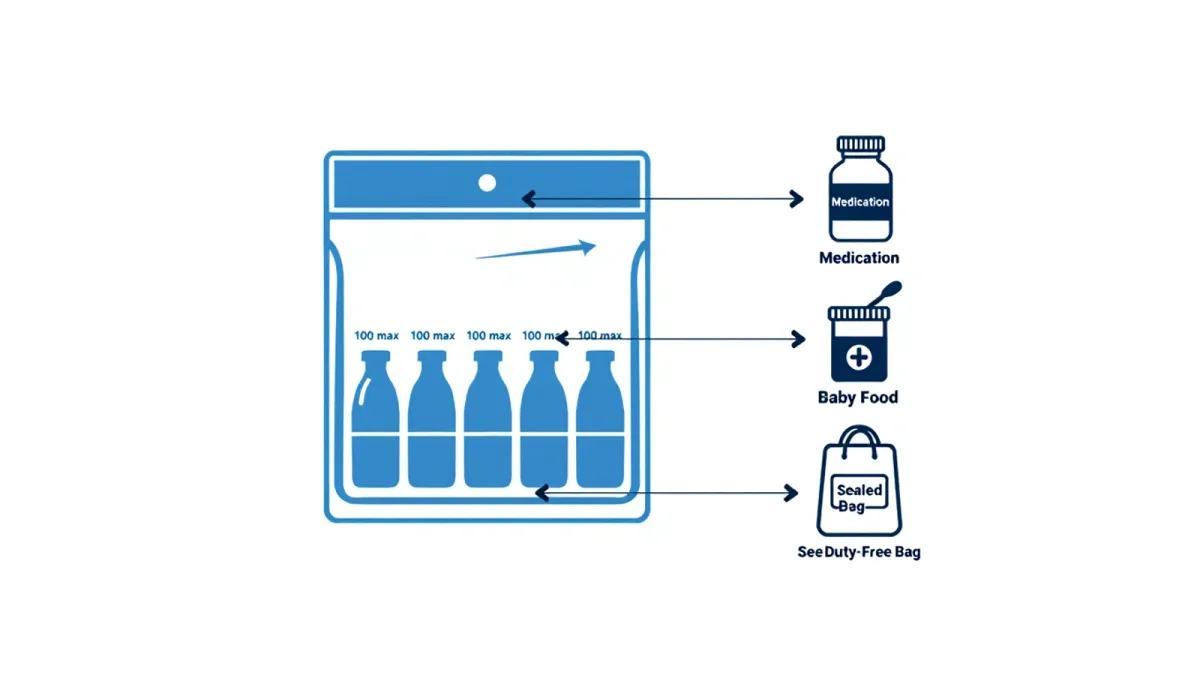
The airport liquids rule caps each container of gel, aerosol or liquid in a carry-on at 100 milliliters, requires all containers to fit in a single clear bag of roughly one liter, and asks travelers to present that bag separately at screening. Medications, baby food and duty-free purchases in sealed bags are exempt. The rule dates to 2006 and remains in force at U.S. checkpoints and across most of the world, though several airports have begun lifting it for passengers who pass through new computed-tomography cabin-bag scanners.
The rules look simple and trip travelers up on the edges — container size versus remaining amount, frozen items, and which countries exempt the bag presentation at all. This guide covers the rule, the exceptions, and where it is genuinely changing. AGLA News publishes information, not travel or legal advice; final decisions rest with the screening officer on the day.
What exactly does the 3-1-1 rule require?
Three numbers structure it: containers of 3.4 ounces (100 milliliters) or less, placed in 1 quart-size (about one liter) clear bag, one bag per passenger. At U.S. checkpoints the Transportation Security Administration asks that the bag come out of the carry-on and lie flat in a bin. The unit of enforcement is the container, not the liquid: a 200-milliliter bottle holding only 50 milliliters of shampoo fails, while a full 100-milliliter bottle passes. Anything larger must travel in checked baggage, where no liquids limit applies beyond airline dangerous-goods rules.
What is exempt from the liquids limit?
Three exemption classes apply nearly everywhere. Prescription and over-the-counter medications in liquid form, including medical freezer packs, are allowed in reasonable quantities for the trip and need not fit the quart bag, though they are declared at screening. Baby food, formula, breast milk and juice for infants are exempt in quantities exceeding 100 milliliters, and in the U.S. and EU, travelers may bring breast milk even when no infant is present on the flight, subject to declaration. Duty-free liquids — alcohol, perfume, cosmetics over 100 milliliters — are permitted only in a sealed, tamper-evident bag with the receipt inside; breaking that seal mid-trip invalidates the exemption at the next checkpoint, which is the trap in any connection that re-clears security.
Where is the rule changing?
New computed-tomography scanners view a cabin bag in three dimensions, letting screeners distinguish liquids from electronics without the bin shuffle, and several regulators have relaxed their rules where the machines are installed. Airports in the United Kingdom and Ireland began removing the 100-milliliter cap for passengers screened through next-generation equipment, and major European hubs are phasing in similar technology on their own timetables — rollout has been uneven, so the limit still applies at many lanes inside the same terminal. The United States has retained the 100-milliliter cap, though TSA has upgraded scanner fleets, and periodically tests procedural changes. The practical advice for 2026: check the specific airport before flying liquid-heavy, and keep containers under 100 milliliters whenever a connection crosses a border, because the strictest checkpoint on the itinerary governs what survives.
What about frozen and unusual items?
Frozen liquids count as liquids once they soften, so ice packs and frozen drinks must be fully solid at screening or fit the exemption as medical items. Aerosols — hairspray, sunscreen, insect repellent — fall under the same 100-milliliter carry-on cap and are limited in checked bags by quantity rules. Contact-lens solution, liquid make-up and toothpaste all count; solid deodorant and lipstick do not. Alcohol over 70 percent alcohol-by-volume is prohibited in carry-ons and most checked bags outright. None of these edge cases is negotiable at the line: the officer applies the published rule, and the published rule measures the container.