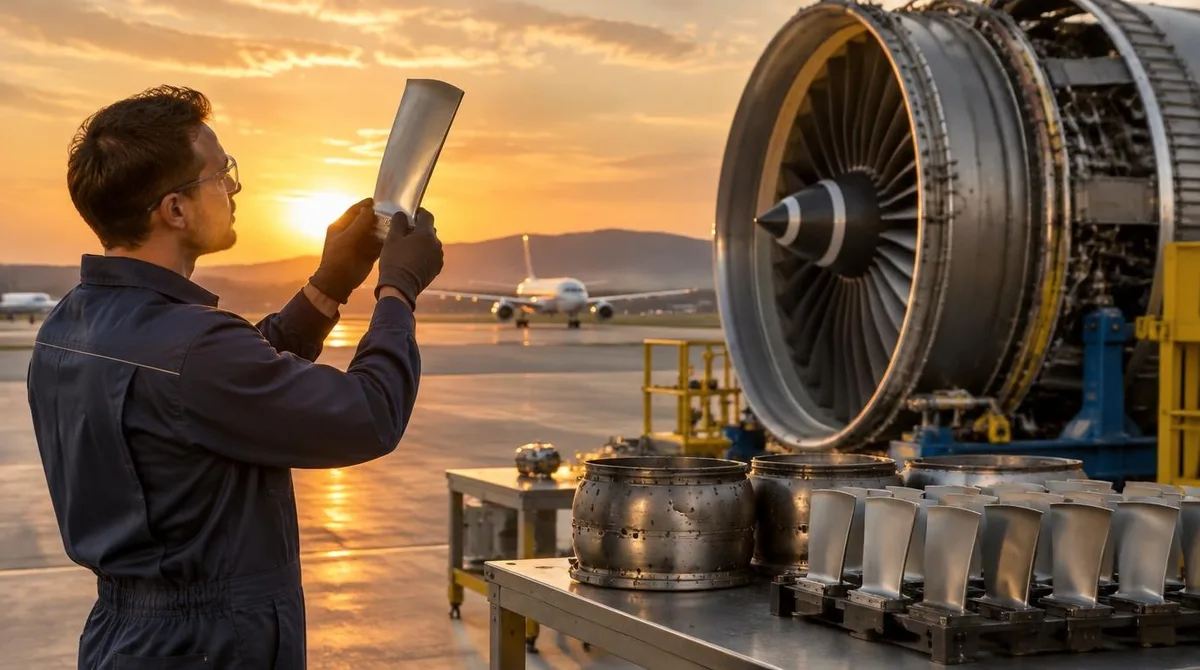
Every new generation of jet engine runs hotter than the last. That is not a design flaw. It is the whole point. Hotter gas squeezes more work out of every drop of fuel.
The catch is that metal melts. The story of modern engines is therefore a story of materials and cooling. Superalloys, single crystals, films of cool air, and ceramic skins all let blades live in gas hotter than their own melting point.
Heat Is Efficiency
An engine's fuel burn depends mostly on two things. One is the pressure from its compressor. The other is the heat of the gas that reaches the first row of turbine blades, according to Wikipedia's jet engine overview. The hotter the gas, the more energy the turbine can take back. The engine burns less fuel for the same thrust.
This is why designers keep raising the heat. A cooler engine is simpler and safer, but it throws away performance. Much of a modern turbofan exists to manage that trade. Readers following this should also see Head-Up Displays in Airliners: Why Pilots Keep Their Eyes Out of the Cockpit.
The Blade Problem
Turbine blades are often the limiting part of a gas turbine, according to Wikipedia's turbine blade article. They sit right in the gas path. They spin at high speed in a stream of burning air. The numbers are stark. Gas leaving the combustor can reach 1,300 to 1,800 kelvin. The blade alloy melts at about 1,300 to 1,400 kelvin.
In plain terms, parts of the engine run in gas hotter than their own melting point. No blade survives that unaided. Engineers close the gap with two tools. They use better materials, and they cool the metal with great care.
Superalloys and Single Crystals
The first breakthrough was metallurgy. Superalloys appeared in the 1940s. Vacuum induction melting arrived in the 1950s and greatly raised the heat that blades could take, according to Wikipedia. Modern blades use nickel-based superalloys with chromium, cobalt, and rhenium in the mix.
Grain boundaries are the joints between metal crystals. Creep and fatigue tend to start there. Directional solidification lined those boundaries up in one direction. Single-crystal casting removed them altogether. Work on single crystals began at Pratt & Whitney in the 1960s. It took about ten years to reach service. The method suits first- and second-stage blades best, where heat and stress peak. One early use of directional solidification was the J58 engine that powered the SR-71. We covered a connected angle in How Fly-by-Wire Works: The Computers Between Pilot and Control Surface.
Cooling: Air Where Metal Should Melt
The second tool is cooling air. It is bled from the compressor and routed through hollow passages inside each blade. Air cooling at 1 to 3 percent of the main gas flow can cut blade heat by 200 to 300 degrees Celsius, according to Wikipedia.
The cleverest trick is film cooling. Small holes let cool air leak out of the blade's surface. It forms a thin layer that shields the metal from the hot gas. A United States Air Force program in the early 1970s funded a blade that combined film and convection cooling. That design is now common. Cooling air is not free. It makes no thrust, so every cut in cooling flow improves fuel burn.
Coatings and Ceramics: The Next Step Up
Thermal barrier coatings added another layer of defense. The first ones, applied in the 1970s, were aluminide coatings. Better ceramic versions arrived in the 1980s. They raised the heat blades can take by about 200 degrees Fahrenheit. In some cases they nearly doubled blade life, according to Wikipedia.
Ceramic matrix composites point further ahead. Silicon carbide composites have stood up to heat 200 to 300 degrees Fahrenheit above nickel superalloys. GE tried them in the low-pressure turbine of its F414 engine. They are lighter and more at home in heat. That lets designers push gas heat that would destroy metal blades.
Conclusion
Jet engines burn hotter each generation because heat buys efficiency. Materials science keeps making that heat survivable. Superalloys, single crystals, internal air channels, film cooling, and ceramic coatings have each moved the limit. The trend will continue as ceramics mature. The hottest engines are still ahead of us.